
Links and buttons marked AD are eBay affiliate links: we earn a commission if you buy after clicking one. It doesn't change the price you pay.
Sony PlayStation (PS1): The Grey Machine That Grew Up With Us
In short
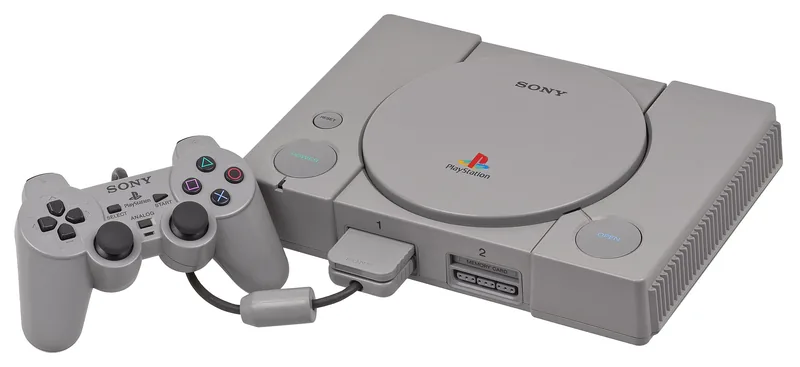
In 1994 a consumer electronics company with no console history walked into a market owned by Nintendo and Sega and, within a few years, took it over. The original PlayStation turned gaming into a mainstream pastime for teenagers and adults, and made CDs the standard for games.
Fun fact: The PlayStation's CPU clock of 33.8688 MHz isn't a random number. It's exactly 768 times 44.1 kHz, the sample rate of an audio CD.
The full story
The US price became legendary: at the 1995 E3 show, Sega announced the Saturn at $399, and Sony's representative simply walked on stage, said "$299" and walked off again.
The origin story is just as famous. The PlayStation grew out of an abandoned collaboration between Sony and Nintendo on a CD add-on for the SNES. When that deal collapsed, Sony carried on alone.
Key games
- Ridge Racer (1994) – a stunning launch title that proved arcade-quality 3D at home.
- WipEout (1995) – built in Liverpool by Psygnosis, with a club soundtrack that made the PlayStation feel effortlessly cool.
- Tekken and Tekken 3 (1995, 1998) – the definitive console fighters of the era.
- Tomb Raider (1996) – Derby-based Core Design created an icon in Lara Croft.
- Crash Bandicoot (1996) and Spyro the Dragon (1998) – Sony's answer to platforming mascots.
- Final Fantasy VII (1997) – the game that brought Japanese RPGs to the masses in Europe.
- Gran Turismo (1997) – the "real driving simulator" and the console's biggest seller.
- Metal Gear Solid (1998) – cinematic stealth that blew everyone's minds.
- Resident Evil, Silent Hill, Castlevania: Symphony of the Night and Oddworld round out a remarkable library.
Cheap CD manufacturing and friendly terms for developers meant the PlayStation attracted an enormous range of publishers, from huge Japanese studios to small European teams.
Sales and legacy
Sony's official figures show that the PlayStation and its slimmed-down PS one model reached 102.49 million cumulative worldwide shipments, with 21.59 million in Japan and Asia, 40.78 million in North America and 40.12 million in Europe/PAL. It was the first console to pass 100 million units, a milestone Sony announced in May 2004. Sony's current business data rounds the total to "more than 102.4 million".
The PS one, a smaller redesign launched in 2000, accounted for around 28 million of those units.
The legacy is enormous. The PlayStation confirmed 3D as the new normal, popularised the memory card, and with the DualShock pad (1997) made dual analogue sticks and rumble essential. Most importantly, it changed the image of gaming in the UK, from bedroom hobby to something advertised in nightclubs and played by people in their twenties.
Sony's PlayStation Classic mini console (2018) was less loved than Nintendo's minis, but many PS1 games are available again through PlayStation Plus Premium.
For the nerds (click to open)
Launch dates and prices
| Region | Launch | Launch price |
|---|---|---|
| Japan | 3 December 1994 | ¥39,800 |
| North America | 9 September 1995 | US$299 |
| UK/Europe | 29 September 1995 | £299 |
UK launch
- When and how much: 29 September 1995 at £299, as listed in the table above.
Chips and specs
| Part | Detail |
|---|---|
| CPU | Custom 32-bit RISC CPU based on the MIPS R3000A, at 33.8688 MHz, with 4 KB instruction cache and 1 KB "scratch pad" |
| 3D maths | Geometry Transformation Engine (GTE), a coprocessor inside the CPU |
| Graphics | Sony GPU with 1 MB of video RAM (frame buffer) |
| Main RAM | 2 MB |
| Sound | Sony SPU with 24 ADPCM voices and 512 KB of sound RAM |
| Drive | Double-speed CD-ROM (up to 300 KB/s) |
| BIOS | 512 KB ROM |
Variants and region differences
- PS one (2000): a smaller, rounder redesign (see the full story).
- Region locking: PAL, US and Japanese consoles only play their own region's discs without modification.
- Model revisions: the Japanese SCPH-1000 had an S-Video output, and early models' RCA (phono) AV jacks were dropped from later revisions.
Values, fixes and builds
Buying tips
- Early models have a reputation for laser and overheating problems; later models are generally considered more reliable.
- Watch out for scratched discs – ask for photos of the data side.
- Black-label PAL originals and Platinum re-releases are both widely available; collectors pay more for the black labels.
Where to buy now
Original hardware is still easy to find second-hand, but condition varies wildly. Check that a console has been tested, look closely at photos of ports and cartridge slots, and remember that a reputable retro shop will usually offer a short warranty that a private seller won't.
Find Sony PlayStation 1 console PAL on eBay UK (opens in new tab) (Ad: affiliate link)