Links and buttons marked AD are eBay affiliate links: we earn a commission if you buy after clicking one. It doesn't change the price you pay.
Nintendo Entertainment System (NES): The Grey Box That Rebooted Gaming
In short
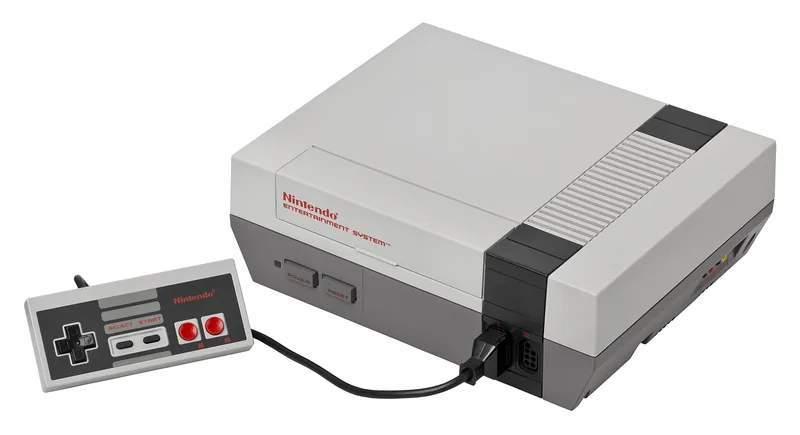
If you grew up with a chunky grey box under the telly and a habit of blowing into cartridges (it never actually helped), this one's for you. The NES didn't invent home gaming, but it arguably rescued it, and its influence is still felt in almost every console on sale today.
Fun fact: Nintendo was so little known in Britain that the NES first arrived through small distributors. Toy giant Mattel took over UK distribution later, and early Mattel-era units carried Mattel branding. Its first high-street stockist was reportedly Boots the Chemist.
The full story
The machine began life in Japan as the Family Computer, or Famicom, a cheerful red-and-white console with hard-wired controllers.
The North American redesign was a clever bit of camouflage. After the 1983 crash, shops were wary of anything called a "video game console", so Nintendo styled the NES as an entertainment system, used a front-loading slot reminiscent of a VCR, and launched alongside the Robotic Operating Buddy (R.O.B.) to make it look less like a video game console.
Key games
The NES library is enormous, but a handful of titles defined the era:
- Super Mario Bros. (1985) – the side-scrolling platformer against which everything else would be judged for a decade.
- The Legend of Zelda (1986) – open-ended exploration, a battery save and that famous gold cartridge.
- Metroid (1986) – moody, non-linear and the start of a whole genre.
- Mega Man 2 (1988) – tough-but-fair action with a soundtrack people still hum.
- Super Mario Bros. 3 (1988 in Japan) – often cited as the high point of the 8-bit era.
- Castlevania, Punch-Out!!, Kirby's Adventure and Final Fantasy – each started or popularised a long-running series.
In the UK and Europe the NES never quite dominated the way it did in Japan and the US; home computers such as the ZX Spectrum, Commodore 64 and Amstrad CPC, plus Sega's Master System, gave it a proper fight in the playground.
Sales and legacy
According to Nintendo's own historical sales data, the Famicom and NES together shipped 61.91 million units worldwide, with around 500 million games sold for the platform – an attach rate of roughly eight games per console. Of those consoles, Nintendo lists 19.35 million in Japan and 34.00 million in the Americas, with the remainder elsewhere.
The bigger legacy is arguably the business model. Nintendo's licensing programme and its "Official Nintendo Seal of Quality" were designed to stop the flood of low-quality games that had helped sink the market in 1983. The lockout chip, the strict publisher limits and the idea of a platform holder curating its shelves all became industry standard, for better and worse.
Creatively, the NES gave us Mario, Link, Samus and countless composers and designers who went on to shape the next forty years. Its D-pad controller layout became the template for nearly every pad that followed.
Nintendo itself has kept the machine alive through re-releases: the NES Classic Mini (2016) sold out repeatedly, and a selection of NES games is available to Nintendo Switch Online subscribers.
For the nerds (click to open)
Launch dates and prices
| Region | Launch | Launch price |
|---|---|---|
| Japan (Famicom) | 15 July 1983 | ¥14,800 |
| North America (NES) | 18 October 1985 (New York test market), nationwide from 27 September 1986 | US$179.99 (1985 Deluxe Set with R.O.B. and Zapper); US$99.99 basic set with Super Mario Bros. from 1986 |
| Europe | 1986 in Scandinavia; UK, Ireland and Italy in 1987 (UK first via HiTech Electronic Services, later Mattel) | Price varied by bundle |
UK launch
- When: mid-1987. Computer & Video Games #68 (June 1987) said the NES was due to launch in the UK in June, and its stockist box named the distributor as HiTech Electronic Services Ltd of Watford. The same issue expected it to sell for around £150. Mattel took over UK distribution later.
- Price (contemporary source): ACE magazine's first issue (October 1987) gave the complete package with R.O.B., the Zapper, Gyromite and Duck Hunt as £159.99. ACE also listed Nintendo game prices in three bands: £19.50, £28.50 and £31.50.
Chips and specs
| Part | NTSC (US/Japan) | PAL (UK/Europe) |
|---|---|---|
| CPU | Ricoh RP2A03 (6502-based core without decimal mode, with the sound hardware on the same chip) | Ricoh RP2A07 |
| CPU clock | 1.789773 MHz (21.477272 MHz master clock ÷ 12) | 1.662607 MHz (26.601712 MHz master clock ÷ 16) |
| PPU (graphics) | Ricoh RP2C02 | Ricoh RP2C07 |
| Work RAM | 2 KB | 2 KB |
| Video RAM | 2 KB (for the background "nametables"; tile graphics live on the cartridge) | 2 KB |
| Frame rate | 60 Hz | 50 Hz |
| Resolution | 256×240 (commonly 256×224 visible) | 256×240 |
So PAL games often ran about 17% slower than their NTSC originals (50Hz vs 60Hz), unless the developer adjusted them. That's one reason some UK players remember Super Mario Bros. feeling slightly sluggish.
Variants and region differences
- Famicom vs NES: the Famicom is top-loading, has hard-wired controllers and a microphone in the second pad, and uses 60-pin carts. The NES is front-loading and uses 72-pin carts with a lockout chip (10NES).
- PAL-A and PAL-B: PAL games come in "A" and "B" regional variants. PAL-A covers the UK, Italy and Australasia, and PAL-B covers most of mainland Europe. The lockout chip prevents some cross-region play.
- Top-loader: Nintendo released a redesigned top-loading NES (NES-101) late in the console's life, in October 1993 in North America. It had no official PAL release.
Values, fixes and builds
Buying tips
- Original front-loaders are famous for a worn 72-pin connector, which causes the dreaded blinking screen. Replacement connectors are cheap and easy to fit.
- PAL games come in "A" and "B" regional variants, so check compatibility if you're importing (PAL-A covers the UK, Italy and Australasia; PAL-B most of mainland Europe).
- Boxed copies with manuals command a big premium; loose carts are the budget route in.
Where to buy now
Original hardware is still easy to find second-hand, but condition varies wildly. Check that a console has been tested, look closely at photos of ports and cartridge slots, and remember that a reputable retro shop will usually offer a short warranty that a private seller won't.
Find Nintendo NES console PAL on eBay UK (opens in new tab) (Ad: affiliate link)