
Links and buttons marked AD are eBay affiliate links: we earn a commission if you buy after clicking one. It doesn't change the price you pay.
Neo Geo: SNK's Arcade in a Box (MVS and AES)
In short
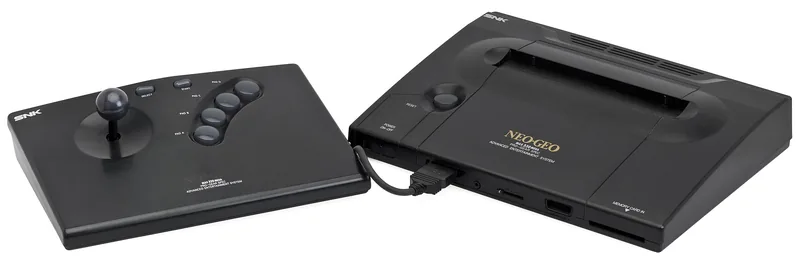
For a while, the Neo Geo was the console every kid dreamed of and almost nobody could afford. The selling point was simple: the home machine ran the same games as the arcade, with nothing cut out.
Fun fact: Neo Geo games were saved to removable memory cards, which let you carry a high score or save from an arcade cabinet to a home AES. It was an early example of a save card shared between arcade and home.
The full story
Two machines, one system
SNK launched the Neo Geo in Japan in April 1990 in two forms that share the same core hardware:
- MVS (Multi Video System): the arcade version, released on 16 April 1990. Operators could fit several games into one cabinet (cabinets came with one, two, four or six slots) and swap cartridges cheaply instead of buying a whole new machine.
- AES (Advanced Entertainment System): the home version, released on 26 April 1990. To begin with you couldn't buy one: SNK supplied it to Japanese video game shops for rental, and only put it on general sale once those rentals proved popular.
Both use a Motorola 68000 at 12MHz with a Z80 handling sound through a Yamaha YM2610 chip, and display 320×224 pixels. The arcade and home cartridges are physically different, so an MVS game won't go into an AES or vice versa. Reportedly, SNK designed it this way to stop arcade operators buying the cheaper home carts.
Key games
- Fatal Fury (1991) and Art of Fighting (1992) – SNK's answers to Street Fighter II.
- Samurai Shodown (1993) – weapons-based fighting and one of the system's best-loved series.
- The King of Fighters series (from 1994) – three-on-three team battles and a yearly fixture.
- Metal Slug (1996) – gorgeous, hand-animated run-and-gun chaos.
- Garou: Mark of the Wolves (1999) – a late, beautiful fighter.
- Magician Lord, NAM-1975 and Baseball Stars Professional – early titles. The first US Gold System came with either Baseball Stars or NAM-1975, and later bundles paired it with Magician Lord and Fatal Fury.
Sales and legacy
The figures usually quoted are about 1 million MVS units and around 410,000 AES consoles, although other sources give different totals. SNK stopped making the AES in 1997, but the MVS kept getting new games until 2004 – an extraordinary run for a 1990 arcade board.
SNK also tried cheaper CD-based versions, the Neo Geo CD, to bring the price of games down. They sold in small numbers and became known for long loading times.
The Neo Geo proved there was a market for premium, no-compromise gaming. The MVS gave small arcades a cheap way to keep fresh games on the floor, and many UK arcades ran one. The AES remains one of the most collectable consoles of all.
SNK's own Neo Geo Mini (2018) and plenty of official reissues on modern consoles keep the library accessible.
For the nerds (click to open)
Launch dates and prices
| Version | Region | Launch | Price |
|---|---|---|---|
| MVS | Japan | 16 April 1990 | — |
| MVS | North America | 22 August 1990 | – |
| AES | Japan | 26 April 1990 | Rental only at first |
| AES | North America | 1991 | US$649.99 Gold System; US$399.99 Silver System |
| AES | Europe/UK | 1991 (date unconfirmed) | — |
In the US, the Gold System came with two joysticks and a game, while the Silver System had one stick and no game. Games cost around $200 or more each, sometimes much more. Allow for inflation and no home console before it had ever cost as much.
Chips and specs (MVS and AES share these)
| Part | Detail |
|---|---|
| Main CPU | Motorola 68000 (HD68HC000) at 12 MHz |
| Sound CPU | Zilog Z80 at 4 MHz |
| Sound chip | Yamaha YM2610 |
| Work RAM | 64 KB |
| Video RAM | 64 KB plus 4 KB of fast VRAM |
| Palette RAM | 16 KB |
| Colours | 4,096 on screen, from 65,536 |
| Sprites | 380 (each 16 pixels wide and up to 512 tall), up to 96 per line |
| Resolution | 320×224 |
Values, fixes and builds
Buying tips
- Original AES cartridges, especially rare titles, can be very expensive. MVS boards and carts are often much cheaper, and converted MVS-based home setups are popular.
- Watch out for reproduction or converted cartridges sold as originals.
Where to buy now
Find Neo Geo AES console on eBay UK (opens in new tab) (Ad: affiliate link)