Links and buttons marked AD are eBay affiliate links: we earn a commission if you buy after clicking one. It doesn't change the price you pay.
Sega Mega Drive / Genesis: Blast Processing and Attitude
In short
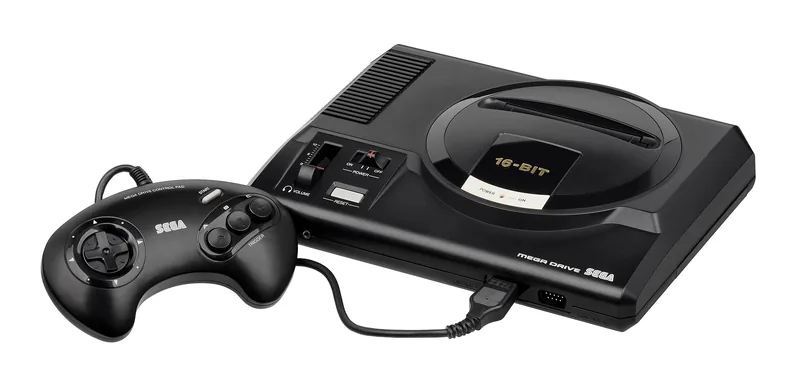
"Sega does what Nintendon't." If you were a kid in the early nineties, the Mega Drive wasn't just a console, it was a side to pick in the playground. Sega's 16-bit machine was faster, louder and cooler than anything before it, and for a few glorious years it had Nintendo genuinely worried.
Fun fact: The Mega Drive has a second processor, a Zilog Z80, mainly to run the sound. Because the Master System was built around a Z80 too, an add-on called the Power Base Converter let the Mega Drive play Master System games.
The full story
In Europe the launch was handled by Virgin Mastertronic, which Sega later bought to form Sega Europe. In North America the machine was renamed Genesis.
Key games
- Altered Beast (1988) – the early pack-in. Not a classic, but "Rise from your grave!" is unforgettable.
- Sonic the Hedgehog (1991) – the game that changed everything. Sega's new mascot was fast, cheeky and the perfect answer to Mario.
- Sonic the Hedgehog 2 (1992) – bigger, faster, with Tails for player two and the famous "Sonic 2sday" launch.
- Streets of Rage 2 (1992) – peak scrolling beat-'em-up, with Yuzo Koshiro's thumping soundtrack.
- Gunstar Heroes (1993) – Treasure's explosive debut and a showcase of what the hardware could do.
- Phantasy Star IV (1993) – an outstanding RPG, though it didn't reach Europe until 1995.
- Golden Axe, Shinobi III, Ecco the Dolphin, Road Rash and Mortal Kombat – the latter famously with the blood available via a cheat code on Sega's version.
Electronic Arts was a huge part of the Mega Drive story too. Its sports titles, from John Madden Football to FIFA International Soccer, were enormous sellers, especially in the UK.
Sales and legacy
The Mega Drive struggled in Japan, where the Super Famicom and PC Engine dominated, but it was a massive hit in North America, Europe and Brazil. By Sega's count it sold 30.75 million units, or around 34 million including Tectoy's Brazilian models. Sega's figures put Japan at about 3.58 million; estimates for North America and Europe vary.
Whatever the exact number, its impact is undeniable. The Mega Drive proved that a challenger could take on Nintendo and win in key markets, with marketing that aimed squarely at teenagers rather than younger children. That rivalry pushed both companies to improve, and arguably helped shape the modern console industry.
Add-ons such as the Mega-CD and 32X were less successful and are often blamed for confusing customers before the Saturn arrived, but they're fascinating collectibles today.
In Brazil, Tectoy has kept the Mega Drive in production in one form or another for decades. Sega's own Mega Drive Mini (2019) and Mega Drive Mini 2 (2022) introduced the machine to a new generation.
For the nerds (click to open)
Launch dates and prices
| Region | Launch | Launch price |
|---|---|---|
| Japan (Mega Drive) | 29 October 1988 | ¥21,000 |
| North America (Genesis) | August 1989 in New York and Los Angeles; wider release in September 1989 | US$189.99 (often rounded to $190) |
| UK/Europe (Mega Drive) | September 1990 in the UK; rest of Europe late 1990 | £189.99 |
UK launch
- When and how much: September 1990 at £189.99, as listed in the table above, which is consistent with RetroTechCollection's spec sheet.
Chips and specs
| Part | NTSC | PAL (UK) |
|---|---|---|
| Main CPU | Motorola 68000 at 7.670454 MHz | Motorola 68000 at 7.600489 MHz |
| Sound/co-processor | Zilog Z80 at 3.579545 MHz | Zilog Z80 at 3.546894 MHz |
| Graphics | Sega 315-5313 VDP (Yamaha YM7101) | same |
| Work RAM | 64 KB | 64 KB |
| Video RAM | 64 KB | 64 KB |
| Sound RAM | 8 KB (for the Z80) | 8 KB |
| Sound chips | Yamaha YM2612 (6-channel FM), plus an SN76489-compatible PSG built into the VDP | same |
| Colours | 512-colour palette, 61 on screen normally | same |
| Resolution | up to 320×224 | up to 320×240 in PAL modes |
Variants and region differences
- Model 1 and Model 2: Model 1 has a headphone socket with a volume slider. Model 2 is smaller and dropped it.
- Cartridge shape: European and US cartridges are shaped differently from Japanese ones (see buying tips).
- Add-ons and offshoots: the Mega-CD and 32X add-ons, and Brazilian Tectoy models (covered in the full story).
Values, fixes and builds
Buying tips
- Early Model 1 boards are prized for their audio quality.
- Genesis and Japanese cartridges use a slightly different shape; a cheap converter or a little care solves most issues.
- Check the power supply – original UK adaptors are often lost or damaged.
Where to buy now
Original hardware is still easy to find second-hand, but condition varies wildly. Check that a console has been tested, look closely at photos of ports and cartridge slots, and remember that a reputable retro shop will usually offer a short warranty that a private seller won't.
Find Sega Mega Drive console on eBay UK (opens in new tab) (Ad: affiliate link)