Links and buttons marked AD are eBay affiliate links: we earn a commission if you buy after clicking one. It doesn't change the price you pay.
Nintendo Game Boy: The Brick That Conquered the World
In short
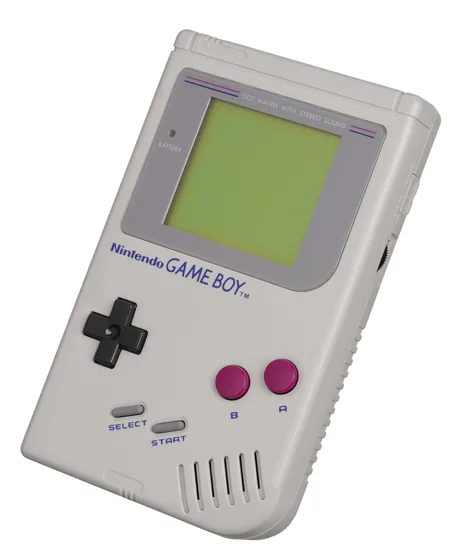
Grey, chunky, with a pea-green screen and no backlight, the Game Boy should never have beaten its flashier colour rivals. Yet it did, comprehensively, and became one of the best-selling gaming machines of all time.
Fun fact: The Game Boy's master clock runs at 4.194304 MHz, which is exactly 2 to the power of 22 cycles per second.
The full story
The handheld was designed by Nintendo's Research & Development 1 team led by Gunpei Yokoi, whose philosophy of "lateral thinking with withered technology" – using cheap, proven parts in clever new ways – explains a lot about the Game Boy. It was affordable, tough and ran for many hours on four AA batteries, while competitors such as the Atari Lynx and Sega Game Gear drained batteries in a fraction of the time.
Key games
- Tetris (1989) – bundled in the West and arguably the perfect handheld game. Many people bought the Game Boy just for this.
- Super Mario Land (1989) – a strange, charming Mario adventure with a fantastic soundtrack.
- The Legend of Zelda: Link's Awakening (1993) – a full Zelda adventure in your pocket, and one of the best in the series.
- Kirby's Dream Land (1992) – Kirby's debut, designed to be friendly for newcomers.
- Super Mario Land 2: 6 Golden Coins (1992) – introduced Wario, who soon got his own series.
- Metroid II, Donkey Kong (1994) and Wario Land – all well worth tracking down.
- Pokémon Red and Green / Red and Blue (1996 in Japan, 1999 in the UK) – the phenomenon that gave the Game Boy a second life late in its career.
The link cable was a key part of the appeal: two-player Tetris and, later, trading Pokémon turned the handheld into a social device.
Sales and legacy
Nintendo counts the original Game Boy, the Game Boy Pocket, the Game Boy Light and the Game Boy Color as a single platform. Combined, they shipped 118.69 million units worldwide according to Nintendo's historical data, with about 501 million games sold. Nintendo does not publish a separate figure for the original model, so any split you see elsewhere is an estimate.
The Game Boy proved that portable gaming could be a market in its own right, rather than a novelty. It kept Nintendo profitable through the 1990s and set up the Game Boy Advance, the DS, the 3DS and, ultimately, the hybrid design of the Nintendo Switch.
Its four-shade display also inspired a whole musical genre: chiptune artists still use Game Boys and software such as LSDJ to make music today.
Classic Game Boy games are available to Nintendo Switch Online subscribers, and modern accessories like replacement backlit screens have made original hardware more playable than ever.
For the nerds (click to open)
Launch dates and prices
| Region | Launch | Launch price |
|---|---|---|
| Japan | 21 April 1989 | ¥12,500 |
| North America | 31 July 1989 | US$89.99 (bundled with Tetris) |
| UK/Europe | 28 September 1990 | Under £100 |
UK launch
- Price: under £100 at the UK launch on 28 September 1990.
Chips and specs
| Part | Detail |
|---|---|
| CPU | 8-bit Sharp CPU, similar to the 8080 and Z80. The chip is labelled DMG-CPU (often called LR35902), and its core is believed to be a Sharp SM83 |
| Clock | 4.194304 MHz master clock |
| Work RAM | 8 KB |
| Video RAM | 8 KB |
| Screen | 160×144 reflective LCD, 4 shades of green |
| Sprites | Up to 40, with 10 per line |
| Sound | 4 channels, stereo through headphones |
| Power | 6 V DC (four AA batteries), about 0.7 W |
Variants
- Game Boy Pocket: a smaller model with a greyscale screen that runs on 3 V (two AAA batteries).
- Game Boy Light: a Japan-only Pocket with a backlight.
- Game Boy Color: 32 KB of work RAM, 16 KB of video RAM and an optional double-speed mode (8.388608 MHz).
- Super Game Boy: a cartridge for the SNES that plays Game Boy games on a TV.
Values, fixes and builds
Buying tips
- The original screen often has vertical lines caused by a failing ribbon connection. It can be repaired, but it's worth checking before you buy.
- Battery compartments can corrode if old batteries were left inside – look closely.
- Many save-game cartridges (Pokémon especially) use internal batteries that will eventually need replacing; fakes are common too, so buy from trusted sellers.
Where to buy now
Original hardware is still easy to find second-hand, but condition varies wildly. Check that a console has been tested, look closely at photos of ports and cartridge slots, and remember that a reputable retro shop will usually offer a short warranty that a private seller won't.
Find Nintendo Game Boy DMG on eBay UK (opens in new tab) (Ad: affiliate link)