Links and buttons marked AD are eBay affiliate links: we earn a commission if you buy after clicking one. It doesn't change the price you pay.
Capcom CP System: CPS1, CPS2 and CPS3
In short
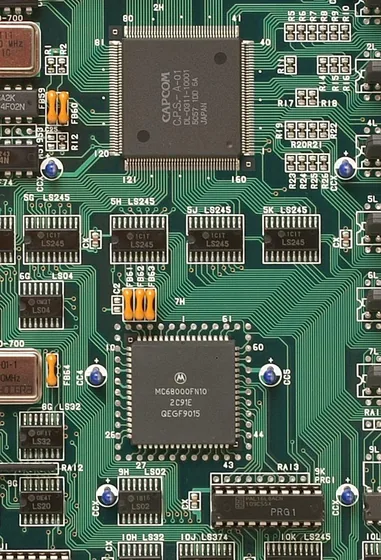
If you fed coins into Street Fighter II, Final Fight or Marvel vs. Capcom, you were playing on Capcom's own arcade hardware: the CP System, short for Capcom Play System. Over three generations it powered some of the most loved 2D games ever made.
Fun fact: The first two CPS1 games used just two circuit boards. Capcom only added the extra small "C board" afterwards, moving logic off the game board.
The full story
CPS1 (1988)
The first CP System arrived in 1988. Its big idea was that each game lived on a removable daughterboard, so operators could swap games without replacing the whole machine. Its library ran well past twenty games.
Key CPS1 games:
- Final Fight (1989) – the template for the scrolling beat-'em-up.
- Strider (1989) – acrobatic and inventive.
- Ghouls 'n Ghosts (1988) – fiendishly hard platforming.
- Street Fighter II: The World Warrior (6 February 1991) – the game that sparked the early-90s arcade revival and the whole fighting game boom.
- Street Fighter II: Champion Edition and Turbo: Hyper Fighting – the follow-up revisions.
Capcom even sold a home version, the CPS Changer, in Japan, in 1994, which let players run arcade game boards at home. Technical support for CPS1 ended on 31 March 2015.
CPS2 (1993)
Bootleg copies of CPS1 games were everywhere, so Capcom's main change for the CP System II was encryption of the program ROMs. The tactic paid off. Pirates were locked out for years, and copies only appeared once people had cracked the encryption.
CPS2 debuted with Super Street Fighter II, released on 10 September 1993 according to the hardware records. It uses a Motorola 68000 at 16MHz, displays 384×224 pixels and adds QSound audio. Each CPS2 setup pairs a common A board with a game-specific B board, and the region is shown by the colour of the case (green for Japan, for example).
Key CPS2 games:
- Super Street Fighter II (1993) and Super Turbo (1994)
- Darkstalkers / Vampire series (from 1994)
- Street Fighter Alpha series (from 1995), ending with Alpha 3 in June 1998
- X-Men: Children of the Atom (1994) and Marvel Super Heroes (1995)
- Dungeons & Dragons: Shadow over Mystara (1996)
CPS2 outlived its own successor. New games kept arriving until December 2003, ending with Hyper Street Fighter II. Capcom wound down most support in March 2015, and its last service, battery replacement, ended on 28 February 2019.
CPS3 (1996)
The CP System III took a different approach. Instead of chunky game boards, operators got a disc and a small security cartridge. A shared motherboard did the heavy lifting, the disc held the game and the cartridge held the keys to unlock it. Discs were cheaper to produce, and the extra colour and sprite power suited very detailed 2D animation.
Only six games were made for it:
| Game | Release |
|---|---|
| Red Earth (War-Zard) | 21 November 1996 |
| Street Fighter III: New Generation | February 1997 |
| Street Fighter III 2nd Impact | September 1997 |
| JoJo's Bizarre Adventure | December 1998 |
| Street Fighter III 3rd Strike | May 1999 |
| JoJo's Bizarre Adventure: Heritage for the Future | September 1999 |
Capcom deliberately kept Street Fighter III in 2D, even as 3D fighters like Virtua Fighter took over. CPS3 was Capcom's last proprietary arcade board before it moved to Sega's NAOMI hardware. Capcom ended most support on 31 March 2015, and battery replacement, its last service, ended on 28 February 2019.
The security cartridges have a reputation for "suicide" failures when their internal battery dies, wiping the keys.
Legacy
The CP System generations cover Capcom's most important arcade era, from the birth of the modern fighting game to the high point of 2D sprite art in 3rd Strike, which still has a competitive following. Many of these games have come home through official collections, such as the Capcom Fighting Collection releases on modern consoles.
For the nerds (click to open)
CPS1 at a glance
| Part | Detail |
|---|---|
| Main CPU | Motorola 68000 at 10 MHz (some later boards 12 MHz) |
| Sound CPU | Zilog Z80 at 3.579545 MHz |
| Sound | Yamaha YM2151 FM plus an OKI MSM6295 sample chip |
| Resolution | 384×224 at about 59.6 Hz |
| Boards | A board (shared), B board (game), and later a small C board |
The Z80 sound CPU runs at 3.579545 MHz (verified on real boards by MAME); sources disagree on the on-screen colour count. CPS2 and CPS3 figures are in the full story above.
Collecting, values and builds
Where to buy now
Find Capcom CPS arcade board on eBay UK (opens in new tab) (Ad: affiliate link)